Will the 2026 Ford E-Transit Finally Deliver a Fully-Electric Camper Van?
The new model comes with longer range, but will it meet the needs of RVers?
Image Caption: Photo Credit: Ford
The promise of an all-electric camper van has loomed over the RV space for several years, with a number of prominent manufacturers teasing potential production models. But aside from a few attempts from smaller startups and a noble attempt by Coachmen, we’ve yet to see a fully electric Class B coach actually go on sale. That could change with the arrival of the 2026 Ford E-Transit, which offers more range and power compared to the previous generation. But there are still some challenges to overcome before we see a true electric RV revolution.
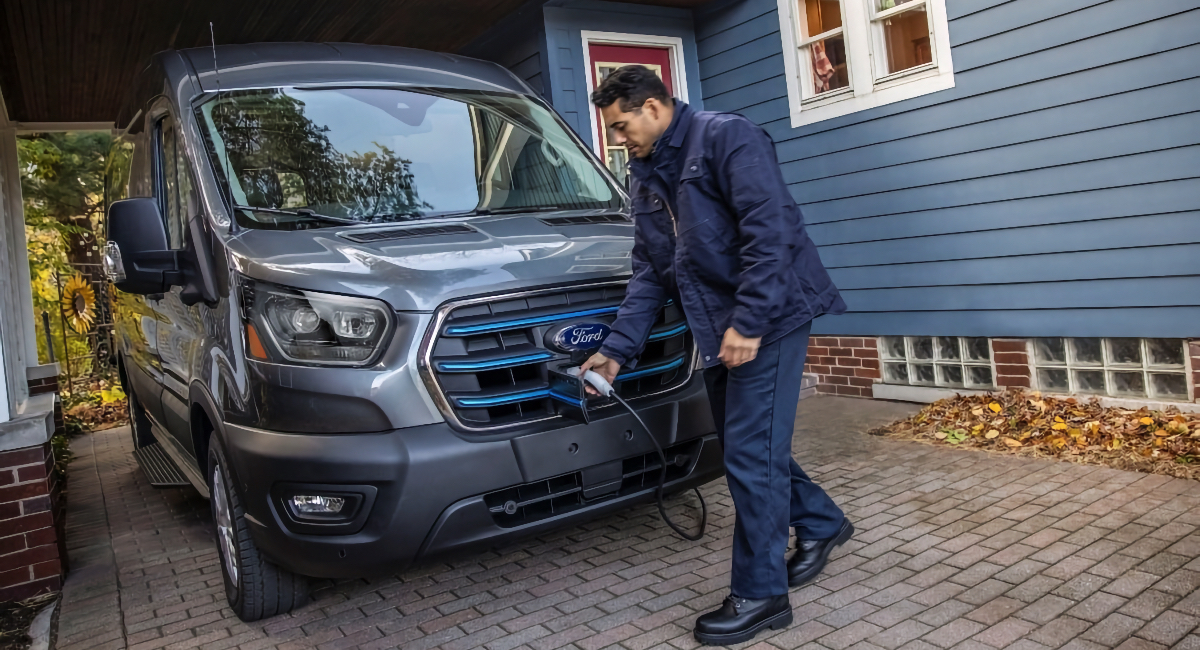
Photo Credit: Ford
The 2026 Ford E-Transit by the Numbers
Ford offers the new E-Transit in multiple configurations, most of which are aimed at the cargo van space. That said, cargo vans have often served as a blank slate for the RV industry, allowing manufacturers to purchase cargo vans and then convert them to campers on their own production lines. That could be the case with this latest E-Transit, which offers so intriguing possibilities for an all-electric model.
Available in two lengths, the “Long” version of the E-Transit measures 19’8” from bumper to bumper and the “Extended” model stretches out to 22’. The van also comes in three heights, with Low, Medium, and High roof options. Unsurprisingly, the “Low” model isn’t particularly well suited for RV living, but both the “Medium” and “High” editions offer more potential for building out the interior. An extended-length, high-roof model offers as much as 536 cubic feet to play with, for example, making it a tempting option for pro and amateur van builders alike.
The E-Transit’s drive train features a 266HP rear electric motor paired with an 89kWh battery, giving it a range of about 159 miles. That’s 50 more miles per charge than the previous electric Transit, which should help alleviate some range anxiety. Still, that’s well below the performance of the Mercedes eSprinter, which can travel more than 200 miles on a single charge. Ford’s latest model does include DC fast charging capabilities that can take it from 20% battery life to 80% in roughly 30 minutes, getting drivers back on the road fairly quickly.
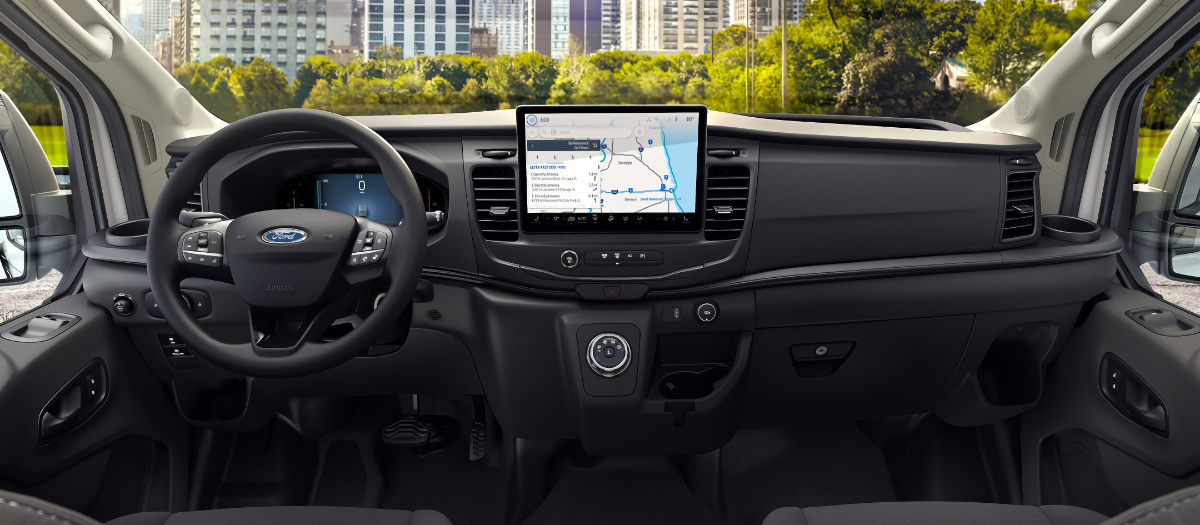
Photo Credit: Ford
Other Features of Note
Ford gave the 2026 E-Transit a variety of new features that should enhance real-world performance. For instance, the latest model now comes with a vapor injection heat pump that improves efficiency when heating and cooling. Other standard features include an 8” driver display and a 12” touchscreen infotainment/navigation system, both of which were optional upgrades on previous models. The system is compatible with Apple CarPlay and Android Auto.
The new E-Transit also comes standard with Ford Co-Pilot 360, which includes a number of driver assurance and safety technologies. It gives owners such handy features as a rearview camera, lane-keep assist, automatic emergency braking, and rear parking sensors. Some models also come with the upgraded Co-Pilot 360 2.0 version, which includes adaptive cruise control, auto lane centering, and blindspot monitoring.
Perhaps the biggest update to the E-Transit is the inclusion of a 5G cellular modem, which can be used as a WiFi hotspot for up to ten devices. This feature is mainly designed for customers who are buying the van for use in a fleet, enabling drivers to stay connected on the road. But having connectivity options for a camper van also makes a lot of sense. Additionally, the cellular connection also enables over-the-air updates to the van’s software, unlocking new features, fixing bugs, and improving performance.
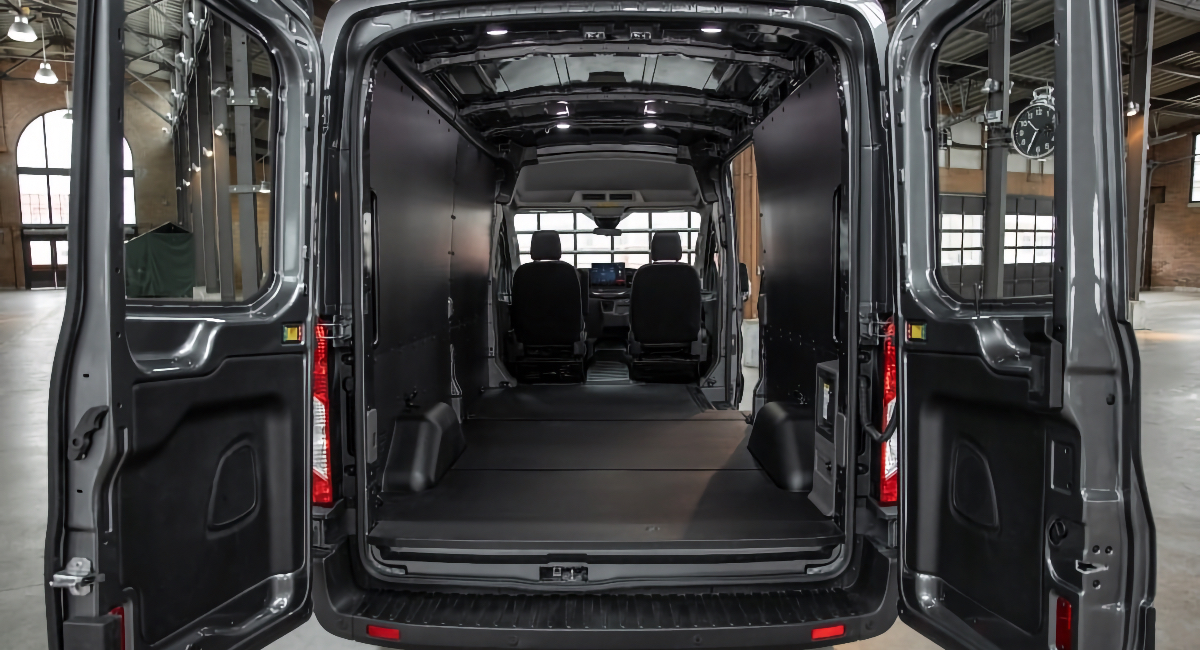
Photo Credit: Ford
A Few Shortcomings
While most of the E-Transit’s specs and features are definite upgrades, there are a few places where it is still a bit lacking. As already noted, the van’s 159-mile range is a considerable increase over the outgoing model, but it probably still isn’t enough to overcome range anxiety for RVers looking to take it on longer road trips. To be clear, the cargo van’s range is perfect for use in and around town, and even short drives out of urban settings. But even with the ability to charge it at a campground, frequent stops to recharge while en route will definitely limit its usefulness as a potential camper van platform.
The 2026 E-Transit is also RWD only, which will likely disappoint some potential buyers, too. Having the option for AWD would be nice, but as many EV owners know, all-wheel drive also cuts into the range of the vehicle. Surely, this was a strategic move on Ford’s part to give the van the best range possible, and its primary customers probably won’t notice. But once again, this could limit its appeal as a camper van, as an increasing number of RV owners look to go off-road and off-grid.
The max cargo capacity for the new E-Transit ranges from 3320-4201 lbs., depending on the configuration. The models that could potentially be used as camper vans would lean towards the higher end of that scale, which should be plenty for a van buildout. But, Ford does not recommend using the van to tow anything, which could also be an issue for some owners. Towing with an EV always puts a big hit on the vehicle’s range, so that is likely the reason the car manufacturer dissuades anyone from even trying. That said, it is also possible that the electric motors simply are reinforced with enough power to handle towing a trailer of any kind.
Photo Credit: Ford
Pricing and Possibilities
One of the Ford Transit’s most appealing qualities has always been its price, and the electric version is also compelling in that sense. The E-Transit Cargo model starts at $53,260, although jumping to the High Roof version increases that price to $56,120 for the Long model and $57,320 for the Extended Length edition. When building a camper van, those numbers are not necessarily out of reach for a major RV manufacturer, but considering the trade-offs noted above, it’s unlikely that the customer base for an E-RV would justify the expense at this point.
Still, it’s becoming somewhat easier to see a future where an electric van becomes a more viable option for building a Class B coach. As the range of these vehicles continues to grow, and charging infrastructure becomes more common, the demand for an all-electric RV will likely increase, too. Such a rig may still be a number of years off, but manufacturing breakthroughs, improved battery tech, and better electrification systems will likely make it a reality in the future.
Indeed, Ford itself has gone back to the drawing board to create a more efficient and cost-effective electrical platform, with the first model—a pick-up of some sort—expected to be announced later this year. Meanwhile, in China, the EV manufacturers are rolling out models with 500+ miles of range that can recharge in as little as five minutes. If those technological breakthroughs continue to expand into new vehicles, it is only a matter of time before we will see a true E-RV for the masses. For now, we’ll just have to continue to wait.
Learn more about the 2026 Ford E-Transit on the company’s website.

Kraig Becker is a writer in the RV, outdoors, and adventure travel space. Over the course of his career he has contributed to such outlets as Popular Mechanics, Outside Online, Business Insider, TripSavvy, Digital Trends, GearJunkie, The Adventure Blog, and countless others. An avid runner and cyclist, he enjoys camping, hiking, mountain biking, kayaking, and just about any other outdoor activity. His travels have taken him to seven continents and on many amazing adventures.