Road Icon: Sailing into History with the American Clipper
When designing this classic RV, Irv Perch thought outside the box-but inside the boat.
Image Caption: Photo Credit: ALAMY
IN 1973, the Sears Tower took over world’s-tallest honors. Billie Jean King hoisted the Battle of the Sexes trophy. And a man named Irving Perch enjoyed retirement–or, at least, his definition of it. Having handed over the keys to his RV manufacturing brand four years prior, Perch spent his days managing the family farm (all 200 acres), collecting vintage planes (including a 1929 Ford Tri-Motor) and operating a restaurant named for his wife, a Flying Lady who was comfortable in the cockpit.
Amid those hobbies, the Californian founder of Aristocrat Trailers created a Class C rig in an effort he called “my encore.” That second wind set sail in the form of the American Clipper. As an industry veteran, Perch recognized that the wood framing and aluminum skins used by RVs of the day commonly led to leaks, rot and structural damage. To avoid those headaches, he crafted the Clipper’s exterior from fiberglass, then primarily used on boats. In another industry innovation, Perch replaced sliding windows with a trio of stacked glass panels that opened out from the bottom, like a vent, and remained usable even in a downpour.
“The American Clipper wasn’t just another motorhome,” says Jose Rodriguez, museum director for the RV/MH Hall of Fame and Museum in Elkhart County, Indiana. “It was an early attempt to solve the RV industry’s biggest problems with modern materials, years before those solutions became standard.”
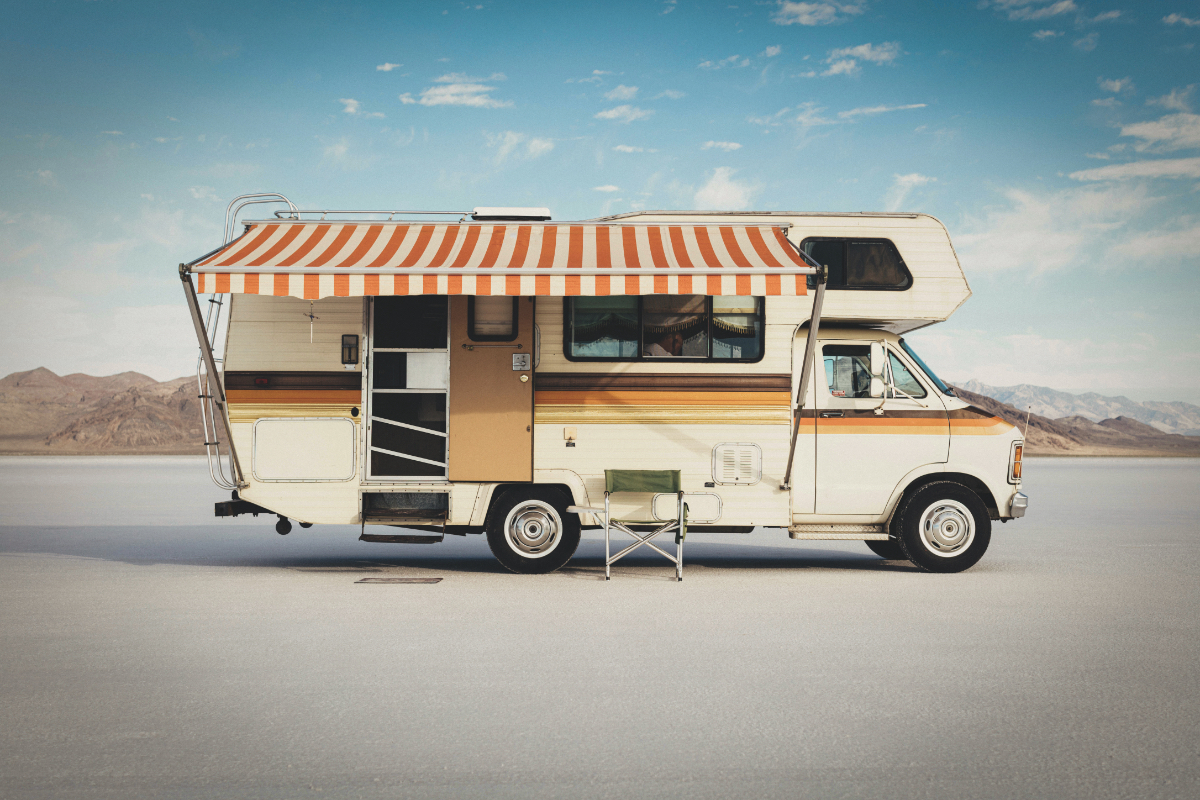
Photo Credit: ALAMY
Perch also squeezed a boatload of luxury into a rig that handily managed a three-point turn in the average parking lot. Most Clippers measured just 21 feet from bow to stern, though two dozen or so extended to 24 feet, resplendent in matching carpet across the floor and walls. They hummed along with 360-, 400- or 440-horsepower engines on a comfort-enhancing van chassis, typically a Dodge Sportsman, rather than a bumpier trailer framework.
All Clippers boasted a four-burner stove and an oven, separate “rooms” for the toilet and shower and a two- or three-way Dometic refrigerator. They slept either four or six, with a number of other layout variations. Clippers also stowed an RV-queen-size mattress above the cab’s throne-like vinyl-and-fabric-covered bucket seats.
“You could see the detail in the way they built them, in the finished work,” says Steven Fine, a proud secondhand Clipper owner and administrator for the American Clipper Fans Facebook page. “In its day, it was a Cadillac.”
By 1980, a second oil crisis, paired with the expense of fiberglass construction and stronger competition, led Perch to halt production after nearly 5,000 units. But despite its relatively short heyday, Rodriguez says, this Class C RV represented such an ambitious foray into integrated, durable construction that the Rand McNally Road Atlas still deemed it worthy of a cover spot in 1992.
Clearly, the Clipper left a legacy in its wake—and gave Perch a pretty impressive curtain call indeed.
This article originally appeared in Wildsam magazine. For more Wildsam content, sign up for our newsletter.