SkyDream Caravans Reveals Ambitious Plans for 2026 Global Launch
The startup has three high-tech travel trailers set to launch in North America, Europe, Australia and other regions.
Image Caption: Photo Credit: Skydream
Last week, RV startup SkyDream Caravans made its splashy debut in the US market, holding a coming-out party of sorts at the glitzy Hayes Mansion in San Jose, CA. There, the company announced its very ambitious plans to grow into a global brand, selling travel trailers in a number of markets around the world—including North America, Europe, and Asia. It even brought a prototype of its first model—the Space Camping—along for the ride, giving attendees a chance to check it out in person. What we saw was a camper brimming with ideas, some good, some still in need of refinement. But the gathering was just as much about showing off a vision for the future of RVing, which includes using technology and AI to overcome the challenges often associated with the lifestyle.
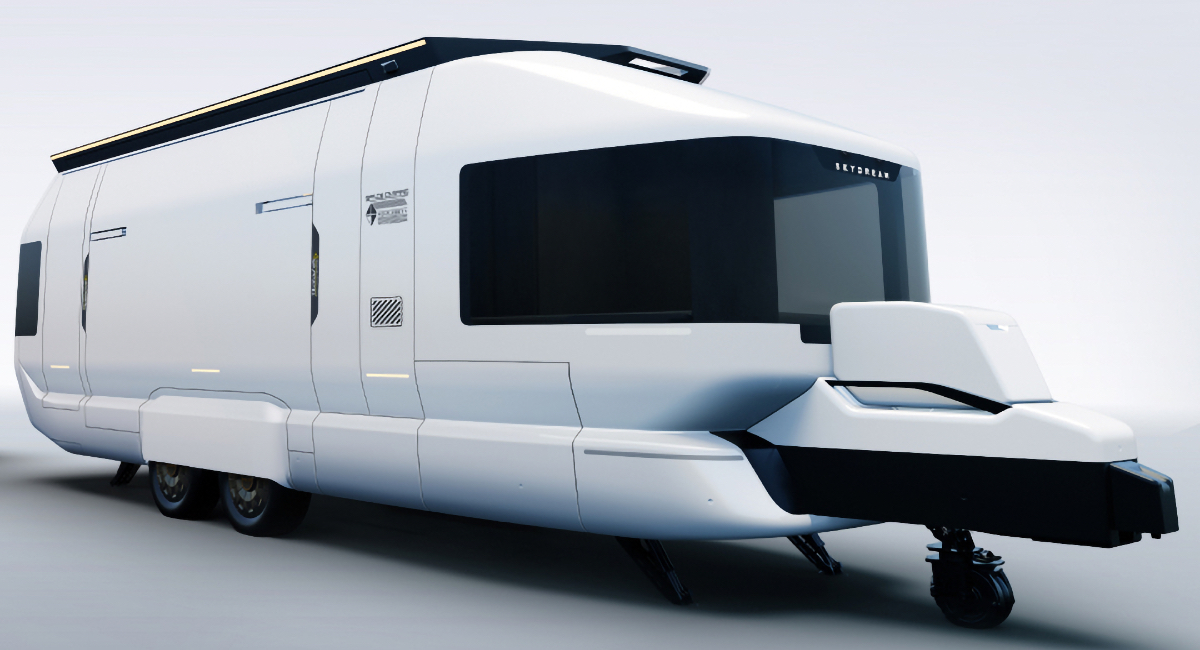
Photo Credit: Skydream
Who is SkyDream Caravans?
Officially founded in 2024, SkyDream is a China-based company that has raised 80 million yuan (roughly $11.6 million) to fund its RV goals. Much of that funding comes from investors like Lion City Capital, Guoke Jichuang, and Tengye Venture Capital, with several other partners signing onto the project. Those backers have allowed the company to build its one-of-a-king intelligent RV prototypes, with the first model making its debut at the 2025 Düsseldorf Caravan Salon in Europe.
According to the company’s press materials, its founders and much of the initial staff have backgrounds in the RV space. The goal is to model the EV market to deliver electric travel trailers with a slew of smart features that make camping easier and more enjoyable. Those include plenty of onboard power storage, solar panels, and energy-efficient appliances and HVAC. Integrated AI will handle tasks like automatically hitching the trailer to a tow vehicle, self-parking at a campsite, and more mundane operations like turning the lights off and on or adjusting climate controls.
As already noted, SkyDream is launching with enormous ambitions. The company plans to offer its RVs in more than 50 countries and regions around the world, which will put it in competition with numerous already-established brands. But, the startup plans to use a similar ramp-up process as Tesla employed more than 15 years ago. Deliver unique and appealing travel trailers that offer amenities not offered by other manufacturers, including software that can be updated to add new features, improve efficiency, and eliminate bugs. The end goal is to sell RVs that are comfortable, easy to use, and eliminate many of the challenges typically associated with RV camping.
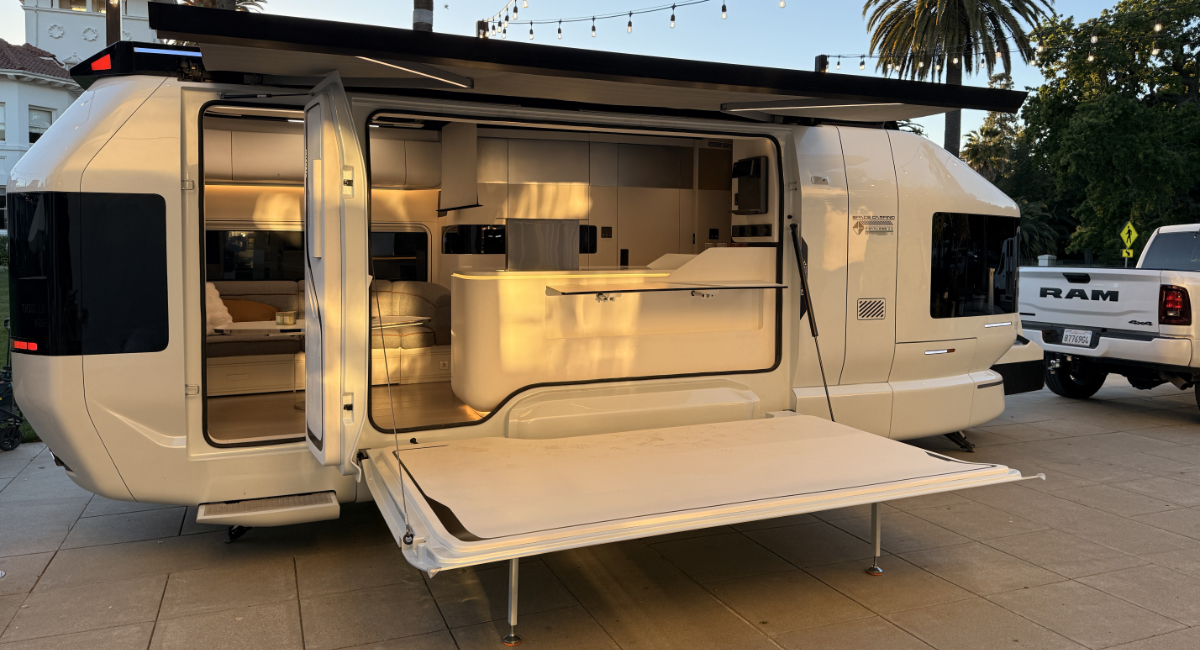
Photo Credit: Kraig Becker
Space Camping Concept Vehicle
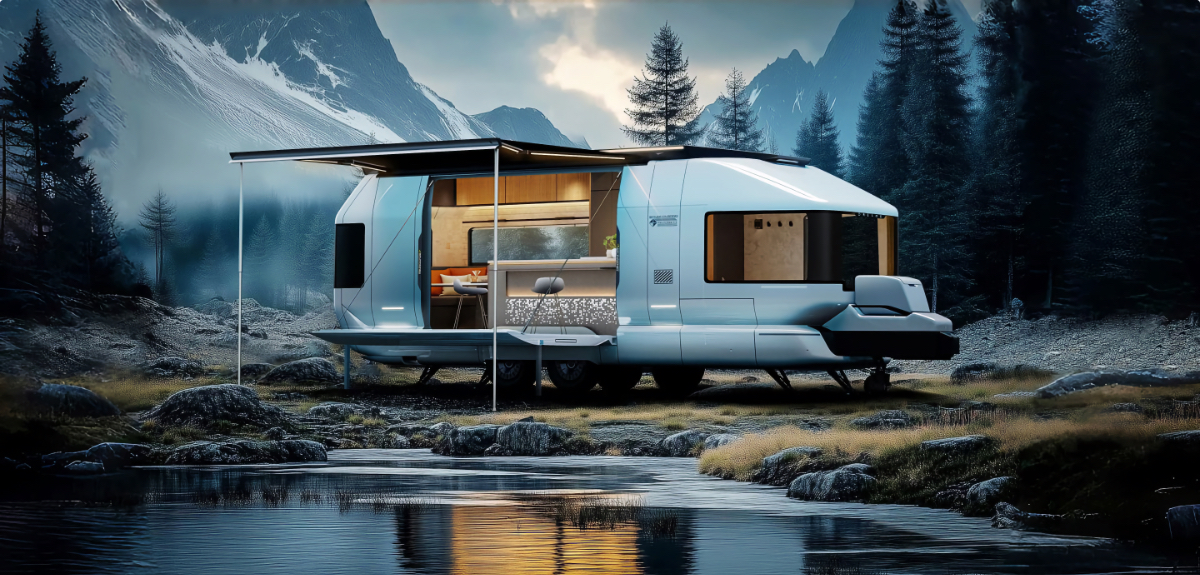
At last week’s event in San Jose, SkyDream showed off its first prototype travel trailer dubbed the Space Camping. This model somewhat resembles other electric travel trailers already on the market, but with its own set of features that allow it to stand out from the crowd. The most prominent of those features was probably its fold-out side patio, which was made of the same fiberglass material used in the construction of the trailer. This gave it plenty of stability and support, making the large deck a popular attraction for many in attendance. When opened, the patio made the interior feel open and airy, particularly on a mostly insect-free California night. But we couldn’t help but think that the lack of a window along that wall would make the trailer feel a bit dark and claustrophobic when closed.
The interior of the Space Camper was otherwise quite nice. It featured a large lounge in the rear with a removable table, a nicely equipped galley kitchen with an induction stove and microwave, and a small, but functional bathroom. The main sleeping area was at the front, where a plush and comfortable bed, surrounded by tinted windows, felt warm and inviting. The rig even included an integrated video projector with a screen that deploys from the ceiling, a washer/dryer combo, and a built-in robot vacuum to clean the floors. A multiplexing system was accessible via a wall-mounted touchscreen, but the beta version of that product was mostly in Chinese, making it a challenge to use at the moment.
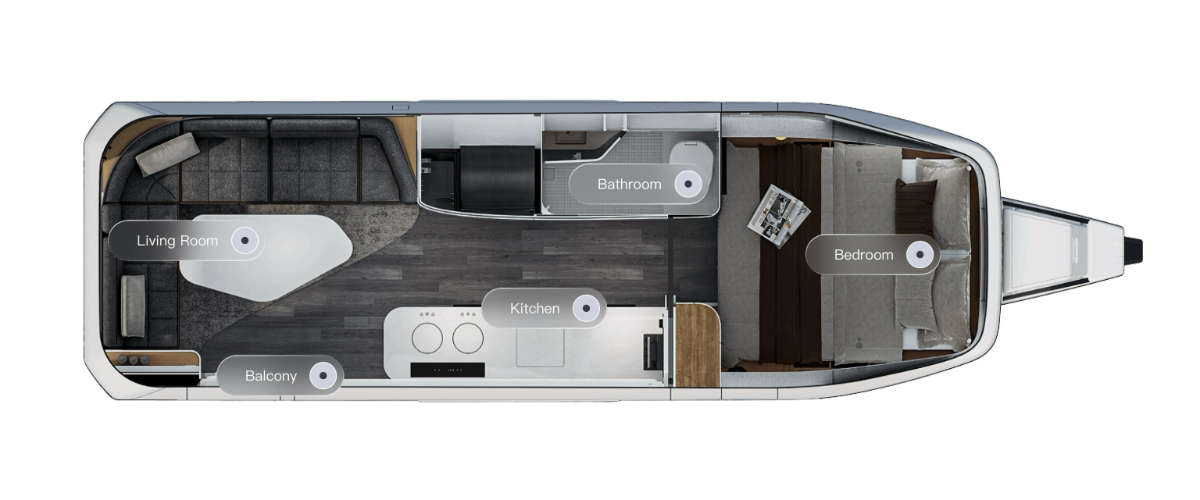
Photo Credit: Skydream
SkyDream says the Space Camping trailer is an all-terrain model, with features designed for off-grid travel. Those include 45-85kWh house batteries and 1100W-2000W of solar depending on the configuration. The final design remains in flux, with multiple floor plans in the works, but we’re told it will measure 22′-33′ in length and will feature the unique, futuristic design on display in the prototype that was on hand at the event. Interior layouts will potentially be vastly different, with more open space and even a user-configurable area with multiple options for what to include there, like a Murphy bed, a desk, or a dinette.

Photo Credit: Kraig Becker (of SkyDream slide)
Future RV Models
In another page ripped right from the EV industry’s playbook, SkyDream is basing all of its future travel trailers on the same interchangeable “skateboard” platform. That chassis will serve as the underpinnings for not just the Space Camping trailer, but also the upcoming Land Yacht and Polar Crossing options, too. Using a universal platform will help streamline production, making it easier to expand the line-up as the company grows. The skateboard also enables many of the high-tech features that all three rigs will share, most notably one-touch hitching and unhitching, automatic parking at home and the campsite, and driver assistance features like traction control, hill-start assist, and active steering assist.
The Land Yacht, which measures 18′-30′ in length, is designed to be the most luxurious of SkyDream’s models. It’s built for use on-road only, with a focus on comfort and convenience. While we weren’t shown a prototype of this model, we did see some concept images. The design includes a modern interior with many of the same features as the Space Camping, along with an exterior with massive windows. That should help make it a favorite with more traditional RVers, although its spacey design may be polarizing.
Meanwhile, the Polar Crossing is SkyDream’s entry into the off-road, overlanding trailer market. It will reportedly be 16-26 feet long, and be designed to go just about anywhere. Its design looks more nimble and rugged, with a focus on functionality, without compromising comfort. Its interior is no less inviting than its siblings, with rich materials and impressive features. The rig should be rated for four-season use, with off-road tires and suspension allowing it to tackle a wide variety of weather and terrain.
As of now, mass production of the SkyDream campers is set to begin in Q3 2026, with shipments starting in Q4 to Europe, Australia, New Zealand, and North America. The Space Camper should be the first model on offer, with the Polar Crossing coming shortly thereafter. Expect the larger and more luxurious Land Yacht to come in 2027. Exact dates and pricing have yet to be announced.
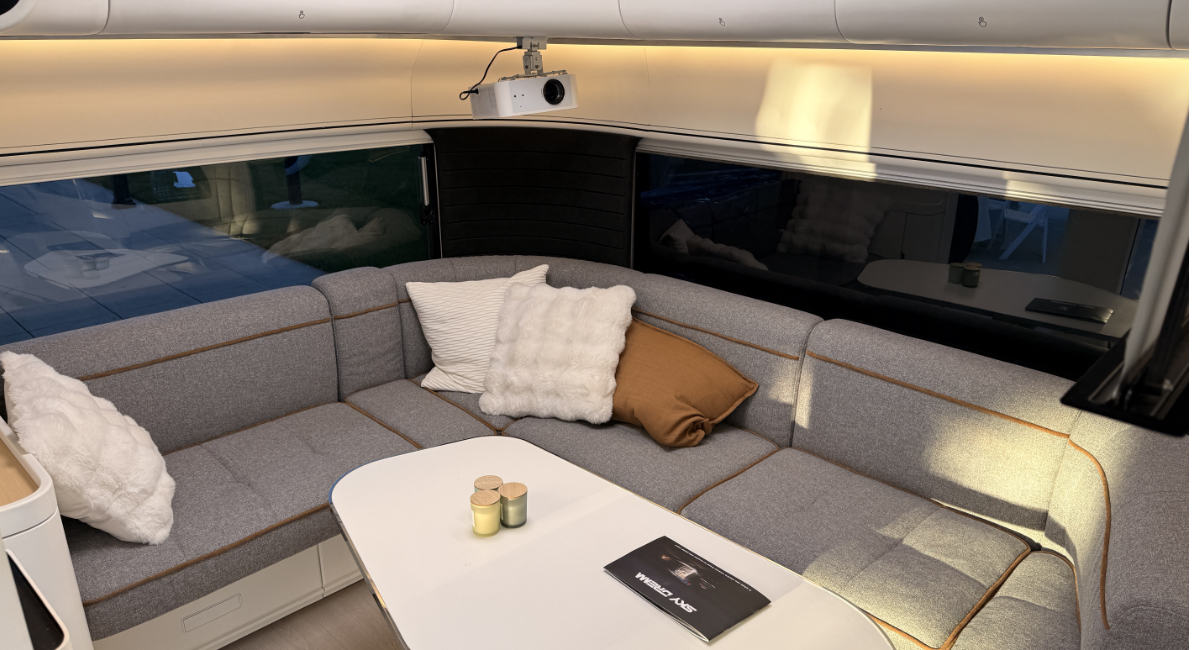
Photo Credit: Kraig Becker
Navigating a Challenging Global Market
Launching as a global brand is a further indication of SkyDream’s ambitions. The company says that it has already established regional headquarters for the markets it is preparing to enter, with production set to begin in those places later this year. While details are light, it appears that manufacturing of various components will take place in China, with the final products getting assembled locally in each region. This could help circumnavigate challenges, like tariffs and potential security concerns, which are hurdles any Chinese brand has to clear. That said, this approach also translates into more jobs within those regions, which is always an quick way to foster goodwill.
Overcoming production challenges is one thing, but building a new brand in the RV space is an entirely different challenge. Companies like Airstream, Winnebago, and Jayco have been around for a long time, and pulling customers away from those established brands is always a challenge, possibly doubly so for a Chinese-based brand. Still, SkyDream is bringing some fresh ideas to the market that could be executed at scale for the first time. To be clear, there are other travel trailer manufacturers building similar products, but for now they are relatively small players in the RV space. SkyDream hopes to be a major player and will likely have the funding and production capacity to match those ambitions. Its high-tech rigs could also attract a new audience. One that is younger, more dynamic, and looking for a comfortable camper that takes much of the hassle out of the process.
Customers will likely have to have deep pockets, too. As noted above, final pricing hasn’t been announced, but considering the technology on offer, these travel trailers won’t come cheap. Operating in the luxury RV space can be tough, but as we’ve seen in the past, if you offer a compelling product with great build quality and unique features, customers will come. Hopefully, SkyDream can deliver on that promise and make some noise in the RV space.
We came away from San Jose impressed with what SkyDream is building, yet still skeptical about whether or not they can pull it off. But the team is talented, smart, and driven, with lots of big ideas and big plans. We can’t wait to see their final models and look forward to those plans coming to fruition. After all, more choice and competition are always a good thing, and this high-tech vision of the future of RV camping is certainly a compelling one.

Kraig Becker is a writer in the RV, outdoors, and adventure travel space. Over the course of his career he has contributed to such outlets as Popular Mechanics, Outside Online, Business Insider, TripSavvy, Digital Trends, GearJunkie, The Adventure Blog, and countless others. An avid runner and cyclist, he enjoys camping, hiking, mountain biking, kayaking, and just about any other outdoor activity. His travels have taken him to seven continents and on many amazing adventures.